Showing posts with label FERRARI. Show all posts

Mansory's Ferrari 458 Italia

Mansory's products are always eye-catching (if not necessarily attractive), whether they be a clear coat carbon Aston Martin named Cyrus or that silly pink Bentley. Beauty, after all, is in the eye of the beholder. That being said, allow me to introduce you to the Siracusa. Rant and rave in the comments below.

Underneath all the new and revised carbon fiber body panels (now with more louvers!) is a Ferrari 458 Italia. Named after a Sicilian raceway, the Siracusa has received a respiratory performance boost to 590 horsepower / 434 kW and 560 Nm / 413 lb-ft representing gains of + 20 hp and + 20 Nm / 15 lb-ft over the standard model.
Thanks to the bump in power and drop in weight, Mansory claims the car will hit 100 km/h (62 mph) in 3.2 seconds and attain a top speed of 330 km/h (205 mph).
The Siracusa rides on 20- and 21-inch wheels (f/r) sheathed in Michelins, while inside is the same old tuner car song: carbon fiber, leather, and ultra-suede. Also, a new suspension setup lowers the car 20 mm. Next!
 

photos


Read more In Cars

Ferrari P540 Superfast Aperta, 2011

Ferrari P540 Superfast Aperta, 2011


The first shake-down has been held at Fiorano of a very special one-off, the Ferrari P540 Superfast Aperta, built for an American client. The car, the second in a new Special Projects programme created by Ferrari to meet requests from the most discerning clients and collectors to create truly unique models, is based on the Ferrari 599 GTB Fiorano and was inspired by a Carrozzeria Fantuzzi-designed Ferrari built specifically for the 1968 Fellini film, Toby Dammit, itself inspired by one of the tales of Edgar Allan Poe.

In accordance with the Special Project's approach to producing such individual one-offs, the Ferrari P540 Superfast Aperta respects all existing international safety and homologation requirements and is thus road legal. The car was designed by Pininfarina and built in Maranello, and the client was directly involved in each stage of its development. As the 599 GTB Fiorano donor car is a coupé, considerable effort went into strengthening the chassis by using finite element analysis in development and the increase in weight was kept down to just 20 kg by employing carbon-fibre extensively. From the initial sketches to the final, road-legal car took just 14 months.

Technical specifications :
    = Length: 4731 mm
    = Width: 1954 mm
    = Height: 1300 mm
    = Wheelbase: 2750 mm
    = Front track: 1690 mm
    = Rear track: 1620 mm
    = Engine
          o Type: 65° V12
          o Displacement: 5999 cc
          o Maximum power: 456 kW (620 CV) at 7600 rpm
          o Maximum torque: 608 Nm (62 kgm) at 5600 rpm
    = Transmission: F1 6-speed gearbox
    = Tyres
          o Front: 245/35 20"
          o Rear: 305/35 20"
    = Fuel consumption
          o Combined cycle: 17.9 l/100 km
          o CO2 emissions: 415 g/km

Ferrari 458 Italia, 2011

Ferrari 458 Italia, 2011


Ferrari 458 Italia, 2011

Ferrari 599XX, 2010

Ferrari 599XX, 2010


Ferrari 599XX, while based on the Ferrari 599 GTB Fiorano with the same transaxle layout and engine type, is an extreme track car. Ferrari's engineers have carried out extensive work on the engine's combustion chambers and inlet and exhaust tracts. These modifications, combined with the fact that internal attrition has been reduced and the maximum revs have been boosted to 9,000 rpm, helped achieve the target power output of 700 hp at 9,000 rpm. Particular attention was also paid to cutting the weight of the engine unit components. This was achieved both by optimising forms - as in the new crankshaft - and adopting exclusive materials, as in the carbon-fibre used for the intake plenums. A new gearbox shift strategy cuts overall gearchange times to 60 ms.

The Ferrari 599XX is characterised by an innovative electronic concept called the "High Performance Dynamic Concept" which has been designed to get the maximum performance from the car by managing the combination of the car's mechanical limits with the potential of its electronic controls. The mechanical and electronic systems work together to get the maximum performance from the car under extreme high performance driving, for consistent lap times. The sporty handling has been improved thanks to the adoption of second generation SCM suspension system. Track usage is also made easier thanks to the new "virtual car engineer", a screen in the car that provides a real-time indication of the vehicle's efficiency.

The Ferrari 599XX's aerodynamics were honed in numerous wind tunnel test sessions with the result that the car now boasts 280 kg of downforce at 200 km/h (630 kg at 300 km/h). The front underside of the body is completely faired-in and the vents that channel hot air from the engine bay have been moved to the bonnet.

The "ActiflowT" system increases downforce and/or cuts drag depending on the car's trim cornering conditions, courtesy of the use of a porous material in the diffuser and two fans in the boot which channel the air flow from under the car out through two grilles next to the tail-lights. Winglets have been added to the rear buttresses to increase downforce. while synthetic jets have also been incorporated into the rear of the car to control and smooth the air flow and to reduce drag.

Ferrari's engineers have also used F1-derived "doughnuts" which partly cover the brake discs and wheel rim. These have the dual function of improving both aerodynamics and brake cooling.

In terms of the bodywork, composites and carbon-fibre have been widely used and the engineers drew on their experience in working with aluminium to reach the weight target. The development of increasingly high-performance materials has also benefited the carbon-ceramic material braking system. The brake pads are now made from carbon-fibre which means that the calipers are smaller whilst guaranteeing the same efficiency. The new racing carbon ceramic braking system also delivers shorter braking distances and is generally more efficient due to the weight saving.

The Ferrari 599XX comes with slick tyres (29/67 R19 Front and 31/71 R19 Rear) specifically developed to maximise stability in cornering and increase lateral acceleration. They are fitted to 19 x 11J wheel rims at the front and 19 x 12J at the rear.

VIDEO: New Ferrari FF

With the recently unveiled all-wheel drive FF (as in Ferrari Four), Ferrari has opened a new chapter in its history. And to prove that they’re confident in the modern “breadvan’s” 4x4 capabilities, the Italians have released a series of photos with the FF being driven on snowy roads. Now, a new video has surfaced on Youtube showing the exotic GT as it’s put through its paces on snow once again. While there’s no impressive sideways action involved, this is the clearest footage of the FF yet. Hit the jump to see the video.
We’ll remind you that the FF is replacing the 612 Scaglietti and it’s the first ever all-wheel drive model to be manufactured by Ferrari. Boasting a 6.3-liter V12 engine producing 660HP, the FF is said to complete the 0-to-100 km/h dash in just 3.7 seconds and reach a top speed of 335 km/h (208 mph). The FF will make its first official public appearance at the Geneva Motor Show in March.


Read more In Cars

Credo E-Bone Designer Takes on the Ferrari Enzo

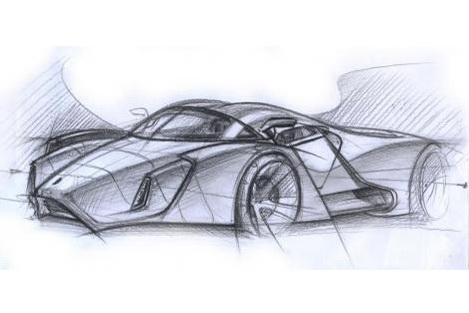
Remember the humorously named yet somewhat plausible Credo E-Bone? It was a design study for a hydrogen powered bus from Hungarian artist Peter Simon, and with a name like "E-Bone", who could forget?
Well, Simon is back, only this time he's taking on something a little more exotic than public transport: he's envisioning the next generation of Ferrari's legendary Enzo. An ambitious task, though one the Hungarian takes on with a plomb.
With more of his trademark organic styling and a design philosophy that both incorporates and rebuffs Ferrari's past and present models, Simon's Enzo is a wonder to behold. From the look of it, Simon's Enzo was hatched, not styled. I can't help but be reminded of the Mitsuoka Orochi: another organically-styled sports car with love it or hate it styling.
A successor to the original Enzo, of which just 400 were produced between 2002 and 2004, has long been rumored though never confirmed by the Italian automaker itself. Whether you love it or hate it, you have to admit: Peter Simon's Enzo is an interesting response to that brief.

 photos


Read more In Cars

Ferrari 599 GTB HY-KERS Concept, 2010

Ferrari 599 GTB HY-KERS Concept, 2010


Ferrari at the 2010 Geneva Motor Show gives the public its first glimpse of the HY-KERS vettura laboratorio which can reduce CO2 emissions by 35 per cent on the combined cycle (ECE + EUDC). The HY-KERS is based on the 599 GTB Fiorano but importantly, the technology may one day be fitted to all future Ferraris, 8- and 12-cylinders alike, regardless of their engine position. Thanks to ongoing research combined with experience gained in Formula 1, the new technology developed at Maranello actually accentuates the cars' sporty character and driving involvement.

One of the principle objectives of the project is ensuring that Ferrari will be in a position to comply with future CO2 emissions standards, particularly in terms of the urban cycle. City driving is traditionally where sports cars are most penalised as their engines are designed for maximum efficiency and performance at high revs, whereas the urban cycle involves low revs and low engine loads.

There are many original aspects to the new Ferrari hybrid transmission, starting with its architecture. Firstly, weight distribution has not been altered. This is thanks to positioning the batteries below the floorpan of the car, and the use of a compact electric motor coupled to the rear of the F1 dual-clutch gearbox. Not only does this layout not affect dynamic performance, it actually improves it, by lowering the centre of gravity. Cockpit room and luggage space are also unaffected.

Maranello's engineers also employed Ferrari's track experience in the design, engineering and manufacture of this innovative electric motor which produces over 100 hp. The algorithms and control logics controlling the torque, traction and braking distribution functions are directly derived from Formula 1.

The solution adopted for the HY-KERS represents just one of the possible technologies for the future, but in the meantime Ferrari continues to evolve its models and increase their overall efficiency. Thus research continues into reducing drag, improving rolling resistance of tyres and lowering weight as well as working on reducing engine friction to increase efficiency.

Ferrari's research into reducing energy consumption has not been focused merely on its cars but also extends to the various production methods employed throughout the Maranello factory where the entire manufacturing process is carried out, from the foundry to the final assembly. In the course of 2010, Ferrari will cut CO2 emissions by 30,000 tons (-40 per cent) and Particulate Matter (PM) levels by 65 per cent. This will be achieved thanks to the company's photovoltaic system and Italy's largest trigeneration plant (which produces electricity, hot and cold water), making Ferrari entirely self-sufficient from an energy point of view. The reduction also means that Ferrari will meet the Kyoto protocol objectives a full 10 years ahead of schedule and with double the figure imposed on Europe.
Related Posts Plugin for WordPress, Blogger...